Workwear Tender Readiness: How to Score Sustainability, Traceability and PFAS Status in Contracts
- Share
- publisher
- UniOuter
- Issue Time
- Oct 6,2026
Summary
Sustainability, traceability and chemical status are now scored criteria in workwear contracts, not optional extras. This guide shows how to write those criteria so they are measurable, what evidence satisfies each one, and how to avoid clauses that suppliers cannot actually meet.

A tender clause that a supplier cannot evidence is worse than no clause at all. It invites a written promise, and a written promise is not a score.
Sustainability, traceability and chemical status are now weighted criteria in corporate and public workwear contracts. This guide shows how to write those criteria so they are measurable, which evidence satisfies each one, and how to structure a contract so the winning bidder can actually deliver what they promised. It follows our custom workwear procurement guide and the safety workwear specification guide.
Why Scored Criteria Beat Statement Clauses
Most contracts currently include sustainability as a policy statement: the supplier agrees to comply with environmental and social requirements. That clause is unenforceable because it has no threshold and no evidence. The alternative is a scored criterion with a defined evidence set, so a bidder either has the document or does not. This is the shift happening across institutional buying, and it is driven by the same reporting pressure that produced the EU Strategy for Sustainable and Circular Textiles.
The test for any clause. Could two different assessors look at the submitted evidence and reach the same score? If the answer is no, the criterion is a statement rather than a requirement, and it will be scored by impression.
Writing the Three Criteria
| Criterion | Write it as | Evidence that satisfies it |
|---|---|---|
| Sustainability | Minimum recycled content percentage by weight, certified to a named standard | Transaction certificate per order plus the standard certificate for the mill |
| Traceability | Named origin for fibre, yarn and fabric, with records retained for a defined period | Mill declarations per batch, filed by style and order reference |
| Chemical status | Explicit PFAS-free declaration for repellent finishes, plus restricted substance limits | Signed declaration plus finished-garment or fabric test report from an accredited laboratory |
Two supporting criteria usually sit alongside these. Social compliance is best written as a recognised audit framework with a maximum audit age, and product durability as a named performance test with an acceptance threshold. Both convert easily into evidence.
The PFAS Clause in Detail
PFAS is the criterion that causes the most confusion in tenders, because the regulatory picture is still developing and suppliers use different vocabulary. The substance class is restricted under REACH, supplemented by national measures, and buyers increasingly require an explicit declaration rather than an absence of mention.
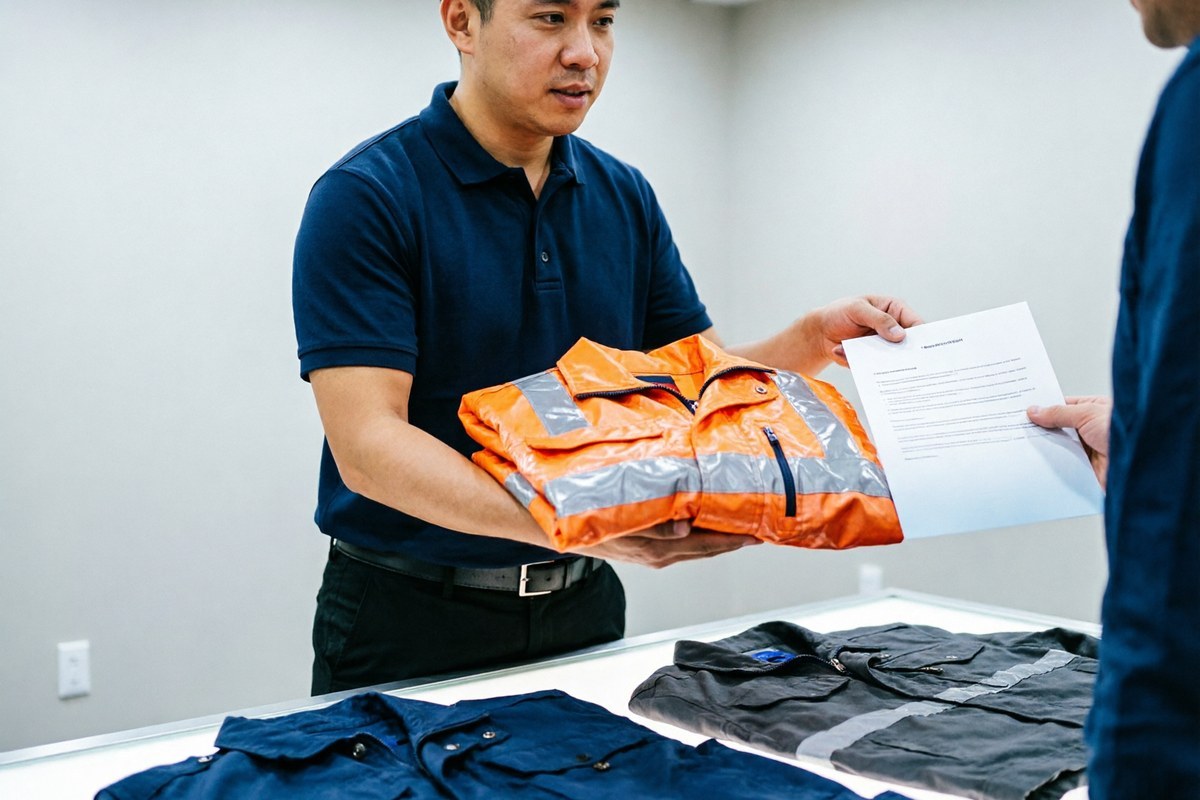
- 1. Require a positive declaration. Ask for a signed statement that the repellent finish is fluorine-free, naming the finish family, rather than relying on silence in a chemical list.
- 2. Name the test basis. Specify the test method and the reporting limit used to demonstrate the absence of the restricted class, so results are comparable between bidders.
- 3. Cover the whole garment. PFAS can appear in face fabric finish, membrane, tape and trims. Scope the declaration to the finished garment, not only the shell fabric.
- 4. Require re-declaration on change. Any change of finish chemistry or supplier should trigger a new declaration and a re-test. Otherwise the clause expires quietly with the first supply change.
- 5. Align with oil repellency expectations. A fluorine-free finish sheds water well but repels oil less effectively. Where oil repellency is needed, specify a wipe-clean or barrier construction instead of a chemistry the supplier cannot supply.
Traceability Requirements That Hold Up
Traceability clauses fail for one reason: they ask for origin data without saying which tier. A requirement to disclose the country of origin should name fibre, yarn, fabric and assembly separately, because those are four different answers and only the fibre tier is genuinely hard to obtain.
Certification bodies are the practical infrastructure here. Chain of custody for recycled content runs through the systems administered by Textile Exchange, chemical input approval through frameworks such as bluesign, and finished-garment chemical testing through OEKO-TEX. Naming one of these in the tender turns a vague expectation into a checkable line.
Scoring and Contract Mechanics

Where UniOuter Fits
We can respond to scored tender criteria with the evidence attached rather than a promise: a PFAS-free declaration for repellent finishes, transaction certificates for certified recycled content, mill declarations naming fibre and fabric origin, and batch test reports for the relevant standards. Where a criterion cannot be met at the stated threshold, we say so before bid submission, which is far more useful than a non-compliant award. Send your tender criteria through our inquiry page and we will return a point-by-point evidence response.

Shop Contract-Ready Workwear

Frequently Asked Questions
Both have a place. Hard requirements suit non-negotiable items such as restricted substances, where failure should disqualify. Scored criteria suit areas with a range of acceptable performance, such as recycled content percentage, where higher performance earns more points.
A signed declaration naming the finish chemistry as fluorine-free, plus a laboratory test report for the restricted substance class using a named method and reporting limit. Scope the declaration to the finished garment, because PFAS can sit in finishes, membranes, tapes and trims.
Require the evidence with the bid rather than after award, and make the documentation pack a payment condition for the first shipment. A supplier who cannot produce the documents at bid stage rarely produces them at delivery stage.
Name the tiers: fibre, yarn, fabric finishing and garment assembly. Only the fibre tier is genuinely hard to obtain, and conflating the four into one undefined origin requirement is what makes traceability clauses unenforceable.