The Economics of Outdoor Clothing Manufacturing: Cost Breakdown and Pricing Strategy
- Share
- publisher
- UniOuter
- Issue Time
- Sep 15,2026
Summary
A detailed cost breakdown of outdoor clothing manufacturing: raw materials, labor, overhead, design, functional treatments, testing, packaging, shipping, MOQ impact, pricing strategies, margins, hidden costs, and cost optimization - with UniOuter's transparent pricing model.

Understanding the true cost structure behind outdoor apparel is essential for brand buyers who want to negotiate effectively, budget accurately, and avoid the hidden expenses that erode margin. This guide breaks down every cost component in outdoor clothing manufacturing, from raw fabric to landed product, with practical pricing strategies and cost optimization tactics.
For context on the sourcing process, see our sourcing guide and manufacturing guide.
Raw Materials, Labor, and Manufacturing Overhead
Raw materials dominate outdoor apparel cost, typically representing 40-55% of the ex-factory price. Fabric choice drives most of this: licensed Gore-Tex membranes carry licensing premiums of 20-40% over proprietary alternatives, while abrasion-resistant Cordura nylon adds cost proportional to denier rating. Insulation materials - whether down or 3M Thinsulate - represent a significant line item for insulated garments.
Labor costs in China have risen steadily, but skilled functional apparel manufacturing commands a premium over basic garment sewing. Workers who can execute taped seams, bonded construction, and complex pocket configurations are more expensive than those producing simple t-shirts. The skill premium is real - and it shows in quality. UniOuter's 20+ years in functional apparel means our production team specializes in exactly these skills.
Manufacturing overhead includes factory operation (UniOuter operates a 20,000 sqm facility), equipment depreciation (laser cutting systems, pneumatic presses, sew-free bonding equipment), energy, and facility maintenance. These costs are distributed across production volume, which is why factories with consistent throughput can offer better pricing than those with irregular orders.
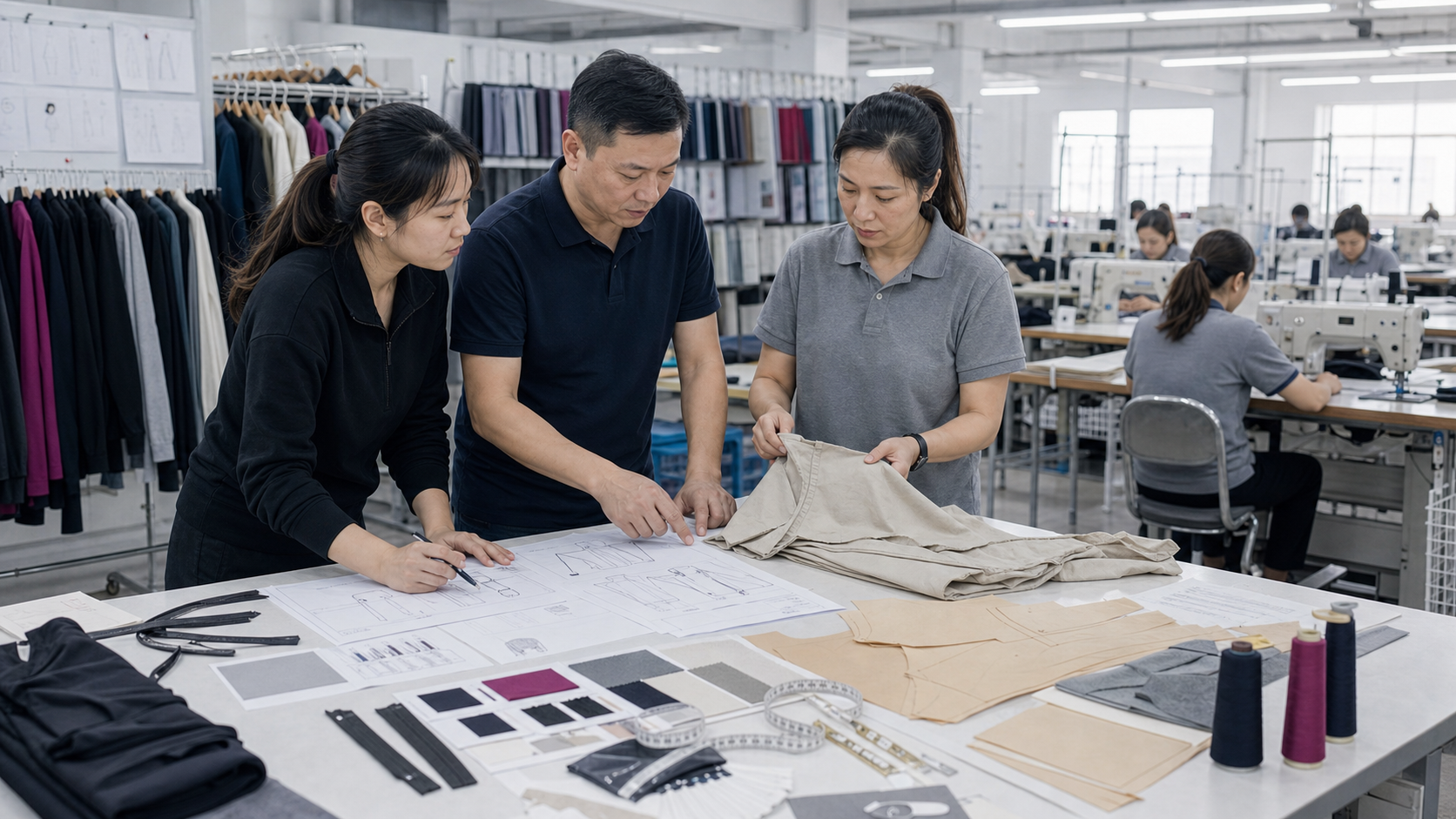
Add photo here: factory production floor with workers sewing outdoor jackets on specialized machines

Design, Development, and Functional Treatment Costs
Design and development costs include pattern making, size grading, prototyping, and fit iteration. For OEM projects, the brand carries design cost; for ODM, the manufacturer amortizes design across multiple clients. UniOuter's 2,000+ developed style library allows ODM-based projects to skip much of this cost entirely.
Functional treatments add per-garment cost: waterproofing (DWR application, seam taping), flame retardant treatment, antimicrobial finishing, and anti-static processing. Each treatment has a material cost and a processing cost - and some require specialized equipment. Seam taping with a pneumatic flat press, for example, is both equipment-intensive and skill-dependent.
The tech pack you provide directly affects development cost: a complete, detailed tech pack reduces sample iterations (each round costs time and money), while a vague brief means more rounds and higher cumulative development cost.
Testing, Certification, and Packaging Costs
Testing and certification costs are often underestimated by first-time buyers. Functional testing (waterproofness via hydrostatic head, breathability via MVTR, wear resistance, seam strength) costs per test per fabric/garment type. Certification renewals - Oeko-Tex, ISO, BSCI, GRS - are annual factory-level expenses that get distributed across production.
Third-party inspection (SGS, BV, ITS) adds $300-800 per inspection visit. For quality-critical programs, multiple inspections across the production cycle are advisable. UniOuter's three-tier QC system (see our QC framework) catches issues internally, reducing the need for extensive third-party intervention.
Packaging costs range from basic polybag + carton (minimal) to retail-ready packaging with hang tags, tissue wrap, and custom boxes. Eco-friendly packaging options (biodegradable polybags, recycled cardboard) typically cost 15-30% more than conventional but align with sustainability positioning. See our design and workmanship page for packaging options.
MOQ Impact and Economies of Scale
Minimum order quantity is the single largest factor in per-unit cost. The economies of scale in apparel manufacturing are significant: a 300-piece order might cost 40-60% more per unit than a 5,000-piece order of the same style. This happens because fabric minimums, cutting efficiency, setup time, and quality control overhead are all amortized across more units.
UniOuter's 300-500 piece MOQ program exists specifically to make startup and small-brand programs viable. We achieve this by grouping small orders efficiently, using our in-house fabric library to avoid minimum-order penalties, and maintaining flexible production scheduling. Explore the product catalog or send an inquiry with your quantity and target price.
Pricing Strategies and Margin Analysis
Three pricing models dominate outdoor apparel: cost-plus (manufacturing cost + fixed margin), value-based (price set by perceived customer value), and competitive (priced relative to market alternatives). Most successful brands use a hybrid: cost-plus as a floor, value-based for premium positioning, competitive benchmarks as reality checks.
Typical margin structures: manufacturers operate at 15-25% gross margin, brands at 40-60% (depending on DTC vs retail channel mix), and retailers at 40-50% markup from brand wholesale. DTC brands capture both brand and retail margin, which is why DTC growth is so attractive - but DTC also carries customer acquisition and fulfillment costs that wholesale doesn't.
For buyers negotiating with manufacturers, understanding this margin structure is leverage. A manufacturer quoting $25/unit at 500 pieces with a 20% margin has room to negotiate on price if you can offer larger volume, longer payment terms, or multi-season commitments. The purchasing guide covers commercial terms in detail.
Add photo here: cost breakdown chart or spreadsheet showing outdoor jacket manufacturing cost components
Hidden Costs and Cost Optimization
Hidden costs erode margin silently: quality failures requiring rework or replacement, returns and warranty claims, expedited shipping when production delays compress timelines, and customs duties that weren't properly calculated. A customs-ready manufacturer with AEO certification reduces customs friction; a robust QC system reduces quality-related hidden costs.
- Specify efficiently. Over-specifying (premium membrane where a proprietary alternative suffices, Cordura where standard nylon works) inflates cost without proportional value. Match spec to end-use.
- Consolidate styles. Multiple colorways of the same style share setup costs. Fewer styles with more colorways cost less per unit than many unique styles.
- Plan ahead. Rush production adds 15-30% premium. The procurement calendar helps avoid rush fees.
- Use ODM where possible. Modified ODM styles save design and development cost while still allowing brand customization.
- Invest in QC. Paying for robust quality control upfront is cheaper than paying for returns, rework, and reputation damage later.
UniOuter's transparent pricing model means itemized quotations with zero hidden fees - fabric, craft, and treatment costs are matched to your budget and clearly documented. Start your costing conversation through the contact page, or learn more about UniOuter.
Shop Outdoor Apparel


Frequently Asked Questions
Raw materials typically represent 40-55% of the ex-factory price for outdoor jackets. The exact percentage depends on fabric type (licensed membranes like Gore-Tex cost more than proprietary), insulation, trims, and hardware. Functional treatments and labor make up the next largest cost blocks.
MOQ has a dramatic effect: a 300-piece order may cost 40-60% more per unit than a 5,000-piece order. This is because fabric minimums, cutting setup, and QC overhead are amortized across more units. UniOuter's 300-500 piece MOQ program is designed to make smaller orders viable without the extreme per-unit premium typical of large-batch factories.
The most common hidden costs are: quality failure rework, expedited shipping from production delays, customs duties miscalculated at quoting, returns and warranty claims, and packaging upgrades that weren't in the original spec. Working with a transparent, AEO-certified manufacturer with robust QC minimizes these risks.
Most successful brands use both: cost-plus as a floor (ensuring you don't sell below manufacturing + minimum margin), and value-based for the actual retail price (set by what your target customer will pay). Competitive benchmarking provides a reality check. Never price below your cost-plus floor, and don't leave margin on the table if your brand commands premium value.
Effective cost reduction strategies include: consolidating styles (more colorways, fewer unique patterns), using ODM bases with OEM customization, planning ahead to avoid rush fees, matching specifications to actual end-use (not over-specifying), and investing in upfront QC to prevent expensive downstream failures. UniOuter's transparent quotation helps you see exactly where costs sit and where savings are possible.